More than a board: Miro, supertutorials, and constructivist learning design on the LLM in Sports Law
by Cem Abanazir, James Brown, Sarah Carrick, Seamus Byrne, Mark James and Kryss Macleod
The LLM International Sports Law and Governance team are Cem Abanazir, James Brown, Sarah Carrick and Seamus Byrne. They are joined and led by Prof Mark James, as programme leader, and were supported in design and development by Kryss Macleod.
Context
The LLM International Sports Law and Governance programme has been developed in a legal education context increasingly shaped by digital collaboration, professional complexity and changing expectations around postgraduate learning. At Level 7, students are expected to work with uncertainty, synthesise material, collaborate effectively, evaluate competing arguments, and begin to position themselves as confident, reflective professionals.
The programme team’s focus was clear from the outset: designing learning spaces in which students could actively construct understanding, connect new material to prior knowledge, test ideas with others, receive feedback, and gradually move toward more independent and sophisticated legal analysis. Miro was identified as a potential tool to support that work; not as an engagement add-on, but as part of a deliberately structured pedagogy.
Through a programme development process focused on the learning cycle, task design, supertutorials, collaborative learning, self-efficacy and metacognition, the LLM Sports Law team explored how different teaching spaces could support students’ movement from initial preparation into shared understanding, and then into higher-order analysis. Within that design, the supertutorial became a key site for pedagogically structured technology use.
What we did
Rather than treating the module as a collection of isolated sessions, the team approached it as a sequence of connected learning spaces. Pre-session learning, the supertutorial and the workshop each had a different pedagogic function. The question was not what content belonged where, but what kind of learning each space should make possible.
Colleagues considered what students needed to encounter before live teaching, and how materials could prepare them for more active work. The workshop then provided space for deeper application, analysis, evaluation and practice.
Between these two spaces, the supertutorial became an axis, designed as a structured, interactive session that could stabilise knowledge, build confidence, and create a shared platform for later workshop activity. This was especially important for an international and mixed-experience postgraduate cohort, where students may enter the programme with different levels of familiarity with legal systems, sports regulation, arbitration, academic expectations and digital collaboration.
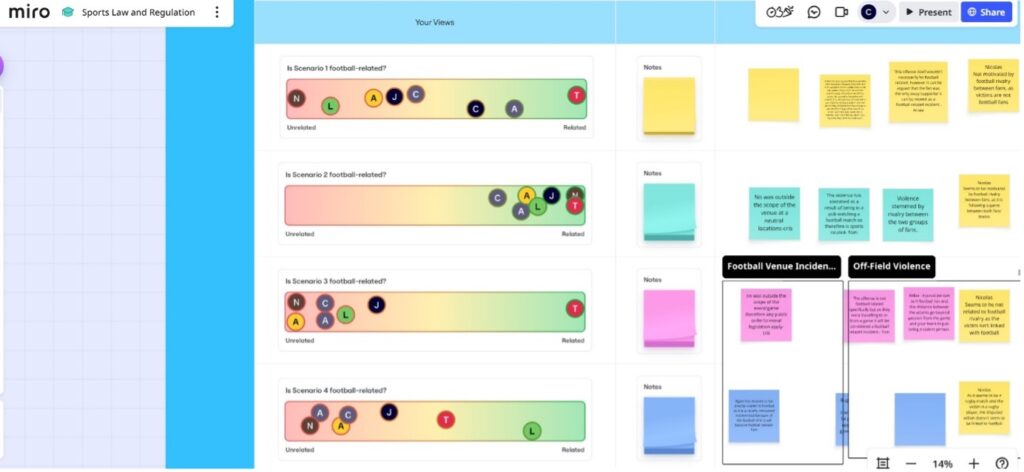
The supertutorial was not imagined as a lecture with a few interactive moments added on. Colleagues were asked to identify what they wanted supertutorials to achieve and how those aims might be realised. The Miro board was designed as a collective learning space: a blend of teaching, interaction and feedback, in which students could make their thinking visible and develop it in relation to others. Miro supports that work really effectively through visual collaboration, sticky notes, templates, maps, sequencing tasks, real-time input and peer comment.
Why Miro worked pedagogically
What made Miro useful was its fit with the constructivist purpose of the supertutorial. It enabled students to work actively with legal material rather than receive it passively. A board task can ask students to organise, classify, sequence, explain, challenge or revise. Those activities are pivotal because understanding is constructed through engagement, rather than transmitted. In their design of tasks, the team aimed for activities that would support this construction of understanding: mapping the arguments in a landmark case, dragging and dropping procedural steps in sports arbitration, sorting cases by jurisdiction or outcome, and using poll-and-reflect activities to check understanding.
Scaffolding was built into the form of the activity. Students could see the structure of a task before being asked to complete it independently: a map, table, procedural sequence or sorting frame gave them a way into complex material. The board therefore reduced the risk that a Level 7 task would be experienced as an unstructured demand to “analyse” or “discuss”. It made the intellectual architecture of the activity visible and provided support within students’ developing zones of competence (Vygotsky, 1978).
Because supertutorials were explicitly designed to build confidence and foundational knowledge, Miro use also aims to support students’ sense of self-efficacy. Confidence develops through incremental success, modelling, feedback and opportunities to recognise progress (Bandura, 1997) and these tasks are more clearly visible in this environment.
Collaboration, too, can become more concrete. Miro can be used to give group interaction a clearer structure: students can contribute to different parts of a board, respond to peers, refine categories, or move from individual observations into shared synthesis. The board created a visible record of collective thinking, rather than leaving interaction as an unrecorded conversation.
For tutors, the board also offered a way to read the room. In teaching spaces, it can often be difficult to see what students understand, where misconceptions sit, or which parts of the material remain unstable. Patterns on the board can be used to intervene, correct, extend or invite comparison. Feedback can therefore emerge during the session, not after the activity has ended.
![Discussion notes on the Sports Law and Regulation Miro board. Different colour post-it notes have been filled in by students. Some of them are organised into different categories: Football venue incidents, off-field violence and racially motivated [incidents].](https://manchester-met-innovate.mmu.ac.uk/wp-content/uploads/sites/494/2026/07/More-than-a-board-2-1024x679.jpg)
Metacognition is also embedded. When students map arguments, sort cases or sequence procedures, they are also inspecting their own understanding. What did they notice first? Why did they classify a case in that way? What assumption shaped the sequence? What changed after peer comment? These traces of thinking-in-progress help students monitor and regulate their learning (Pintrich, 2002).
In this way, digital capability was developed in the LLM without detaching it from disciplinary learning. Our MLS LLM digital framework emphasises communication, collaboration, information literacy, digital learning and ethical use of digital tools. In the Miro-enabled supertutorial, students practise digital collaboration as part of legal analysis, not as a separate employability exercise.
What we learned
The central lesson was more familiar than new, but bears repeating: pedagogically meaningful technology use depends on the learning design around it. Miro was not introduced as a general engagement tool. It answered a specific design problem: how can a postgraduate teaching space support active construction of understanding, confidence-building, feedback and collaborative legal reasoning?
Understanding what you want to achieve in a teaching space is essential, because digital tools can easily create an illusion of participation. Sticky notes are not, by themselves, evidence of understanding: the educational value comes from the design, interactions, and structure around the tool. In other words, the learning outcomes had to guide the technology use, rather than the technology imposing a rigid digital template on the module.
This was echoed in the patterns of use that played out across the academic year: tutors adapted their use to work with the needs of the cohort and module. This unevenness across modules was useful rather than problematic. Different modules used Miro to different extents, depending on their activities, assessment patterns and intended learning outcomes. A digital learning environment should not require every module to look the same. It should give colleagues a repertoire of possibilities, while leaving room for disciplinary judgement about what will support learning in that particular context.
The work also showed the importance of staff development. Colleagues needed time to think through what the supertutorial was for, which activities were worth visualising, what students should produce, and how the Miro board would support confidence and foundational knowledge without flattening the complexity of Level 7 study. That design work is easily missed when digital technology is presented as a ready-made solution.
We also learned something more practical about digital friction. Because Miro was not integrated within the Teams environment, some students preferred to remain in the Teams space rather than move into another digital platform. This was not resistance to collaboration but shows that each additional platform can create a small barrier to learning. For students, especially in a busy postgraduate environment, the smoothness of the route into the activity matters.
Transferable insight
For colleagues considering similar tools, the question is not “Should I use Miro?” but “What kind of thinking do students need to construct together, and what structure would help that thinking become visible?”
These questions may be useful:
- What does the supertutorial space need to achieve before students enter smaller-group or independent work?
- Where do students need to classify, sequence, map, compare or test ideas collaboratively?
- How will the shared board generate feedback that students can use in the next stage of learning?
- Does the value of the tool outweigh any digital friction involved in moving students into another space?
Used well, Miro can support a more collaborative, visible and confidence-building learning environment. Used superficially or imposed where it does not serve the learning outcomes, it risks becoming another surface-level digital activity. The difference lies in design.
The LLM International Sports Law and Governance offers a useful example because it starts from pedagogy. Technology is asked to serve a constructivist account of learning: students build understanding through structured activity, social interaction, feedback and reflection. In that sense, the board is not the innovation. The more interesting innovation is the careful design of the conditions in which students can think together, see their progress, and develop confidence in complex legal work.
References
Bandura, A. (1997) Self-efficacy: The exercise of control. Macmillan.
Pintrich, P.R. (2002) ‘The role of metacognitive knowledge in learning, teaching, and assessing’, Theory into practice, 41(4), pp. 219–225.
Vygotsky, L.S. (1978) Mind in Society: Development of Higher Psychological Processes. Harvard University Press. Available at: https://doi.org/10.2307/j.ctvjf9vz4.