Learning across borders through online collaboration in human resource management
by Dr Fabio Rizzi
Dr Fabio Rizzi is a Tutor in the Department of People and Performance at Manchester Metropolitan University and Assistant Professor of Organisational Behaviour at Rennes School of Business. A Senior Fellow of Advance HE, he specialises in human resource management, organisational behaviour and educational innovation, designing learning experiences that connect international collaboration with authentic organisational practice.
Internationalisation is often associated with travel. Yet many students cannot participate in physical mobility, and travel alone does not guarantee meaningful intercultural learning. In spring 2026, colleagues at Manchester Metropolitan University and Rennes School of Business tested a curriculum-based alternative: Collaborative Online International Learning (COIL).
Context
The pilot connected postgraduate students studying Diversity and Inclusion at Manchester Met with students studying Strategic Human Resource Management at Rennes. COIL uses purposeful online collaboration to bring international perspectives into students’ ordinary programmes, rather than treating mobility as the only route to an international experience (Beelen and Jones, 2015; Rubin, 2016).
As a member of staff at both institutions, I identified a natural meeting point between the units: talent management. Decisions about whom organisations define as ‘talent’, where they invest in development and which roles they consider replaceable are inseparable from questions of diversity and inclusion. The Rennes students were also completing internships, so they could bring current organisational experience; Manchester Met students could bring a more focused diversity and inclusion perspective.
Our original ambition quickly met practical constraints. The academic calendars did not align, teaching materials had already been released, and the project was being organised only weeks before delivery. Rather than abandon it or build an over-complex design, we agreed on a ‘minimum viable COIL’: simple enough to run responsibly, but substantial enough to test whether students and staff could collaborate across the two institutions.
Implementation
Staff allocated students to mixed teams of four, normally two from each institution, and initiated first contact to reduce the friction of finding partners. Each team produced a pre-recorded video of at least five minutes analysing the talent management strategy of an organisation familiar to them and relating it to diversity and inclusion policies and practices. Rennes students led on the organisational context, talent management content and overall structure; Manchester Met students led on diversity and inclusion research. Every team still had to negotiate meeting times, presenting, editing and the division of work.
Participation was voluntary in this first cycle and encouraged through transparent local incentives. Students who completed the activity also received a co-branded certificate. Because teams drew on workplace examples, we asked them to rely on information that could be shared appropriately and to anonymise details where necessary. The bounded task and flexible cloud-based submission kept the technology secondary to the learning. This kind of explicit scaffolding is central to effective virtual exchange (O’Dowd, 2018).
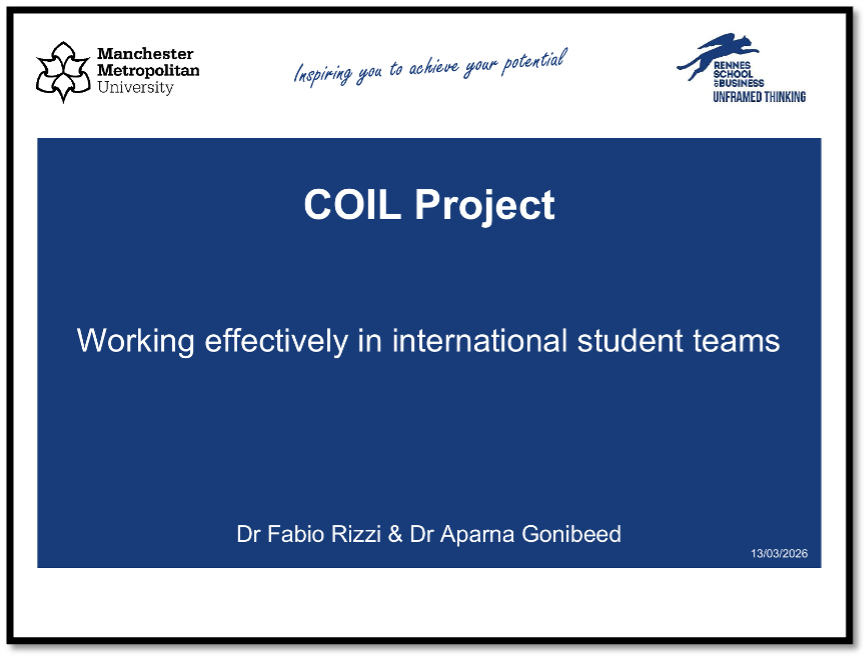
A joint Teams session on 13 March made the often-hidden process of international teamwork visible. We discussed why first meetings can feel awkward, how expectations and communication styles differ, and how using English as a shared language can affect pace and confidence. Students were encouraged to speak clearly, avoid side conversations that excluded others, invite quieter members into the discussion, prepare questions and agree the purpose of each meeting. This was not an etiquette extra: it was part of the learning. The project asked students not merely to exchange content, but to notice and negotiate the conditions under which international collaboration works.
Outcomes
Two mixed teams completed and submitted video analyses, and students who completed the process received the joint certificate. The videos provided a tangible outcome and showed that the two disciplinary perspectives could be combined in one authentic task. They also gave colleagues a workable model that could be repeated and strengthened.
We had not built a formal pre- and post-project evaluation into this short-notice pilot. I therefore would not claim that it demonstrated measurable gains in intercultural competence. The evidence is more modest: completed student work, staff learning and proof that the collaboration was feasible despite calendar and assessment constraints. That limitation is itself useful. Evaluation needs to be designed alongside an innovation, rather than added afterwards.
What we learned
First, calendar alignment must begin before teaching starts. Early agreement on recruitment, assessment, data sharing and staff workload would allow the collaboration to be embedded more fairly and reduce reliance on last-minute goodwill.
Second, motivation is not enough: students need a participation architecture. Central team allocation, a staff-facilitated introduction and explicit responsibilities reduced coordination costs. A short team charter and early formative checkpoint would make expectations clearer and surface uneven participation sooner.
Third, language confidence needs planned support. Asking students simply to ‘work in English’ is not inclusive design. Templates for first messages, clear turn-taking norms, preparation time and reassurance that understandable English matters more than perfect English can widen participation.
Finally, authentic workplace learning needs an explicit ethical frame. Organisational examples made the task relevant, but the next brief should say more about confidentiality, anonymisation, evidence and the responsible use of generative AI.
Next steps
For the next iteration, we plan to establish a co-owned annual timeline, add a short team charter and formative check-in, and gather concise student reflections and peer feedback. We will also provide guidance on confidentiality and AI use, and use the evidence to decide how the activity could be integrated fairly into assessment. The aim is not to scale quickly, but to preserve the focused, authentic task while improving support and evaluation.
Internationalisation at home does not require elaborate technology. It requires a meaningful shared problem, a clear structure for participation and permission to learn from inevitable friction. For us, the pilot turned two neighbouring curricula into a temporary international classroom and provided a practical roadmap for building a stronger one.
References
Beelen, J. and Jones, E. (2015) ‘Redefining internationalization at home’, In Curaj, A., Matei, L., Pricopie, R., Salmi, J. and Scott, P. (eds.) The European Higher Education Area: Between Critical Reflections and Future Policies. Cham: Springer International Publishing, pp. 59–72.
O’Dowd, R. (2018) ‘From telecollaboration to virtual exchange: State-of-the-art and the role of UNICollaboration in moving forward’, Journal of Virtual Exchange, 1(1) pp. 1–23.
Rubin, J. (2016) ‘The Collaborative Online International Learning Network: Online intercultural exchange in the State University of New York Network of Universities’, In O’Dowd, R. and Lewis, T. (eds.) Online Intercultural Exchange: Policy, Pedagogy, Practice. New York: Routledge, pp. 263–270.
Acknowledgements
The pilot was co-designed with Dr Aparna Gonibeed, Andrea Subryan and Reece Garcia at Manchester Metropolitan University, with support from Sarah Hudson, Ljupka Naumovska and colleagues at Rennes School of Business.