
BOOST: Breaking down barriers to academic success through bite-sized support
by Corrinne Millard, Leena Parmar, Lisa Appleyard-Keeling and Louise Barnes
Corrinne Millard, Leena Parmar, Lisa Appleyard-Keeling and Louise Barnes are a collaborative team of Programme Support Tutors in the Department of Social Care and Social Work, focused on improving student success and belonging through the development and delivery of impactful student support initiatives.
Transitioning into higher education (HE) is rarely a uniform experience. For many students, particularly those from non-traditional backgrounds, it can feel uncertain, unfamiliar, and, at times, overwhelming. Research highlights that prior educational experiences significantly shape students’ transition into HE (Timmis et al., 2024), while those without access to the ‘hidden curriculum’ often lack the cultural capital needed to fully engage and succeed (Koutsouris et al., 2021).
Within Social Care and Social Work (SCSW) at Manchester Met, this challenge is especially pertinent. We have a range of undergraduate, postgraduate, and apprentice programmes in health, social care, and social work. These are both based at campus, and offsite – including nationally. Approximately 73% of students hold vocational qualifications, 66% are first-generation, and many are apprentices or balancing work alongside study (Mulkeen et al., 2017). For these learners, flexibility and accessibility are essential. Additionally, non-traditional students can perceive higher education as an unfamiliar space where they may struggle to feel a sense of belonging (Gabel, 2022).
Introducing BOOST
In response, the BOOST initiative, led by Programme Support Tutors, was developed to bridge this gap. BOOST delivers short, accessible, online study skills sessions during lunchtime and early evening slots, times that work around students’ existing commitments. These sessions focus on ‘bite-sized’ academic skills, making learning manageable, targeted, and immediately applicable.
At its core, BOOST aims to illuminate the ‘invisible’ aspects of academic success (Hubbard et al., 2020). These are the unwritten expectations, how to approach reading, write critically, engage with feedback, and think like a scholar, that many students are not explicitly taught.
While the focus of BOOST is on developing academic skills, a central emphasis has been placed on building students’ confidence. Each online session is facilitated by a Programme Support Tutor, who introduces key academic skills in plain, accessible language, encourages questions, and provides reassurance throughout. This demystifying approach helps to make expectations explicit and manageable. As a result, students have reported increased confidence alongside a stronger sense of belonging.
Aims of the programme
BOOST was designed to:
- Demystify the hidden curriculum.
- Extend knowledge and application of academic skills.
- Build confidence in scholarly activity.
- Refresh key academic skills for returning learners.
- Enhance student autonomy.
- Strengthen students’ sense of belonging.
All SCSW students were invited to participate, ensuring equity of opportunity across the student body.
A holistic approach to accessibility
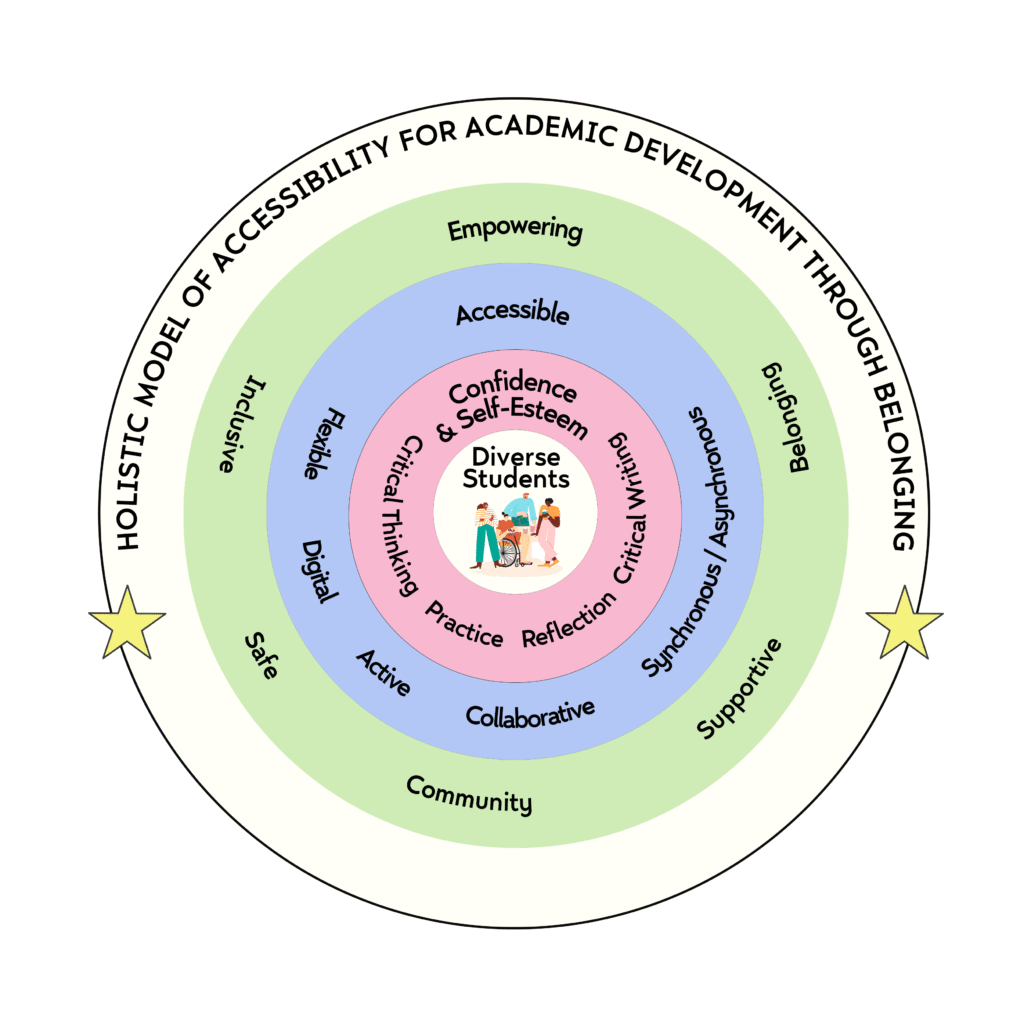
A key underpinning of BOOST is the Holistic Model of Accessibility (HMoA) (Kelly et al., 2008). This learner-centred framework recognises that students’ experiences are shaped not only by individual needs, but also by:
- Institutional structures
- Subject disciplines
- Wider cultural and socio-political contexts
By adopting this model, the BOOST initiative ensured its design was inclusive and responsive to the complexities of students’ lives.
To maximise accessibility:
- Sessions were delivered online.
- They were scheduled flexibly at lunchtime and early evening.
- Recorded materials and resources were uploaded to Moodle for asynchronous access.
This approach enabled students to engage in ways that suited their personal, professional, and academic commitments.
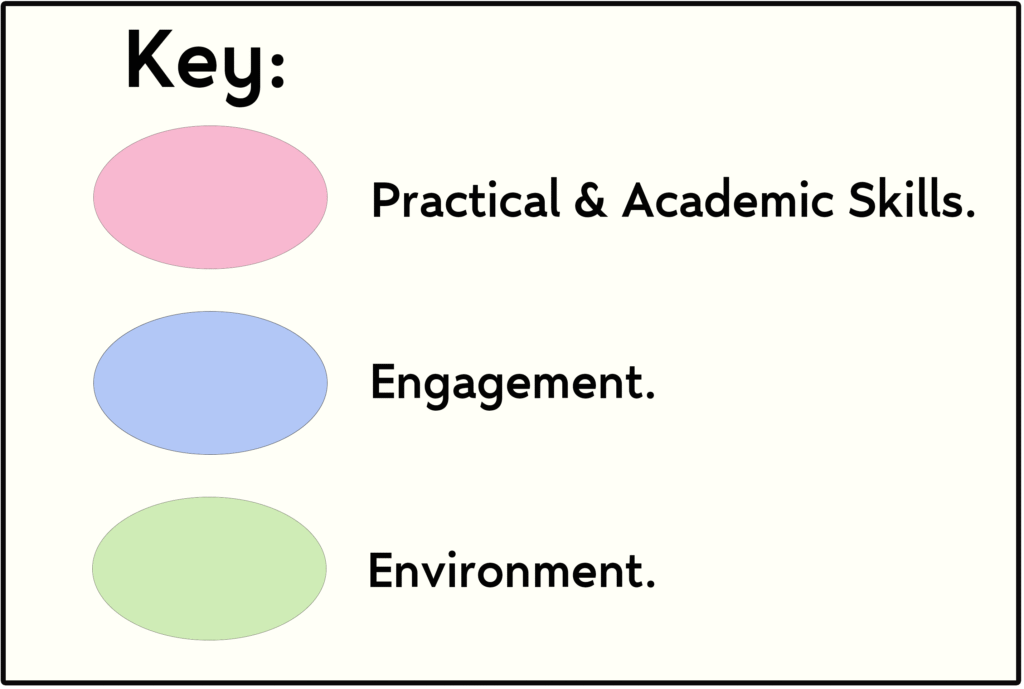
Informed by HMoA, we designed a nested ecological model (below) which incorporates the factors of practical and academic skills, engagement and environment.
Belonging and confidence: Impact and student voice
Developing students’ confidence and self-esteem has been central to BOOST. Research shows that positive self-esteem correlates strongly with improved academic performance (Li et al., 2018).
Student quotes – Feedback on the sessions:
“It’s been another amazing session, thank you so much, I’m more confident returning back to uni tomorrow!”
“I enjoyed the three sessions I attended, all full of great content that I found really helpful and delivered in a way that I understood.”
“I’ve learned a lot this past hour, thank you for giving such good examples! Especially linking theory to experience and reflection models.”
Impact
The impact has been both measurable and meaningful:
- 64 students participated across the sessions.
- Feedback was overwhelmingly positive.
- Students reported that the sessions:
- Catered to diverse learning preferences
- Helped them connect with peers
- Delivered clear, engaging, and relevant content
Crucially, every student reported increased confidence in their understanding of academic expectations following participation.
Beyond skills development, BOOST has contributed to something equally important: a stronger sense of belonging. By creating a supportive, low-pressure environment, students are empowered to ask questions, share experiences, and recognise that they are not alone in their learning journey.
Looking ahead
The success of BOOST signals an opportunity to build on this work. The next phase of the project will focus on developing a RISE BOOST Study Pack, ensuring that resources are sustainable, scalable, and embedded into the wider student learning experience.
Final thoughts
BOOST demonstrates the powerful role Programme Support Tutors within the department of SCSW can play in shaping inclusive academic support. By recognising the diverse realities of students and addressing the hidden barriers to success, initiatives like this go beyond skills development – they transform confidence, belonging, and student agency.
In doing so, BOOST not only supports transition into higher education but redefines what accessible, student-centred learning can look like at Manchester Met.
References
Hubbard, K., Gawthorpe, P., Fallin, L and Henri, D. (2020) ‘Addressing the Hidden Curriculum during transition to HE: the importance of empathy,’ Hinchcliffe, T. (eds) The Hidden Curriculum of Higher Education. AdvanceHE. Available at: AdvHE_Hidden Curriculum_1597673443.pdf.
Kelly, B., Nevile, L., Draffan, E., & Fanou, S. (2008) ‘One world, one web … but great diversity. Paper presented at the 2008 international cross-disciplinary workshop on Web accessibility (W4A), Beijing, China. Available at: One world, one web … but great diversity | Proceedings of the 2008 international cross-disciplinary conference on Web accessibility (W4A).
Koutsouris, G., Mountford-Zimdars, A., and Dingwall, K. (2021) ‘The ‘ideal’ higher education student: understanding the hidden curriculum to enable institutional change.’ Research in Post-Compulsory Education, 26(2), pp.131–147. Available at: https://doi.org/10.1080/13596748.2021.1909921.
Li, J., Han, X., Wang, W., Sun, G. and Cheng, Z., (2018) ‘How social support influences university students’ academic achievement and emotional exhaustion: The mediating role of self-esteem.’ Learning and individual differences, 61, pp.120-126.
Mulkeen, J., Abdou, H. A., Leigh, J., & Ward, P. (2017) ‘Degree and Higher Level Apprenticeships: an empirical investigation of stakeholder perceptions of challenges and opportunities.’ Studies in Higher Education, 44(2), pp.333–346. Available at: https://doi.org/10.1080/03075079.2017.1365357.
Rowe, A. D., Jackson, D., and Fleming, J. (2021) ‘Exploring university student engagement and sense of belonging during work-integrated learning.’ Journal of Vocational Education & Training, 75(3), pp.564–585. Available at: https://doi.org/10.1080/13636820.2021.1914134.
Timmis et al., (2024) ‘Previous education experience impacts student expectation and initial experience of transitioning into higher education’. Frontiers in Education, (9). Available at: https://doi.org/10.3389/feduc.2024.1479546.