
Bridging the digital literacy gap: A student-led approach to developing essential digital capabilities
by Emily Conyard
Emily Conyard is a Lecturer in Digital Marketing and Digitally Enhanced Learning Teaching and Assessment (DELTA) and AI Lead for the Faculty of Business and Law. Her work focuses on digital literacy, AI education and curriculum innovation, leading initiatives that develop digitally capable, future-ready graduates through technology-enhanced learning.
Context
In the UK, approximately 7.5 million people lack the essential digital skills required for work (UK Parliament, 2024), while only 32% of Generation Z feel they have access to the resources needed to develop the digital skills required for future employment (Salesforce, 2022). Furthermore, the demand for digitally capable graduates continues to grow, with millions of additional digitally enabled roles expected in the coming years. This aligns closely with an integral part of Manchester Metropolitan’s education strategy, the Digitally Enhanced Learning Teaching and Assessment (DELTA) strand which works to transform student experience through active learning communities.
Within higher education, students are often assumed to be “digital natives” who can confidently navigate and evaluate online information. However, research has shown that students can struggle to critically assess the credibility and quality of internet sources (Choi, 2020). Given the increasing reliance on digital information in the workplace, these evaluative skills are recognised as essential business competencies (Zarzosa & Ruvalcaba, 2025). The importance of such skills is further emphasised in the Skills England Annual Skills Report, which identifies digital literacy as a core transferable capability across a broad range of occupations (Skills England, 2026).
This project sought to address these challenges through a structured intervention designed to assess, develop, and evaluate students’ digital literacy using the Jisc Six Digital Capabilities Framework (Jisc, no date).
Implementation
The project had three key objectives:
- Assess students’ baseline digital literacy capabilities using a structured self-assessment aligned to the Jisc framework.
- Implement targeted interventions, including RISE training and curriculum-embedded activities, to enhance students’ digital confidence and competence.
- Evaluate the impact of the intervention to inform future scalable approaches across programmes and faculties.
Students completed the Jisc Digital Capabilities self-assessment at the start and end of the project to measure their progress. The question set was informed by the wider Jisc Digital Capabilities framework. Volunteers were recruited from Faculty of Business and Law’s Marketing, International Business and Tourism (MIBT) student representatives, creating a motivated cohort willing to engage with the pilot.
A hybrid delivery model was adopted, alternating between online and face-to-face sessions. Following their initial assessment, students received personalised Jisc reports that categorised their capabilities as Developing, Capable, or Proficient. These reports informed session planning, enabling activities to be tailored to areas of lower confidence.
For example, where problem-solving scores were below average, students were presented with unstructured digital challenges requiring them to troubleshoot independently. Rather than providing step-by-step instructions, facilitators encouraged exploration, discussion, and collaborative problem-solving in small groups. Sessions were intentionally open-ended and heavily reliant on peer feedback, allowing students to share experiences, challenge assumptions, and learn from one another.
The Jisc framework proved particularly valuable in breaking down the broad concept of digital literacy into manageable themes. It also enabled facilitators to design confidence-building activities that directly addressed identified skills gaps.
Outcomes
The Jisc sector benchmark discussed below is derived from responses submitted through the Digital Capabilities Discovery Tool (Jisc, no date) by students across participating higher education institutions, providing a comparative measure of digital capability against a broad peer cohort.

Compared with this benchmark, the cohort demonstrated substantial progress (Figure 1). Initial results placed students below the sector average in eight digital capability areas. Following the intervention, participants exceeded the sector average across all measured capabilities. Importantly, no students were classified as Developing in any digital capability area during the reassessment, whereas the initial assessment identified Developing-level skills across nine capability topics. Consequently, all students progressed into the Capable or Proficient categories, indicating a marked improvement in their self-reported digital capabilities relative to sector norms.
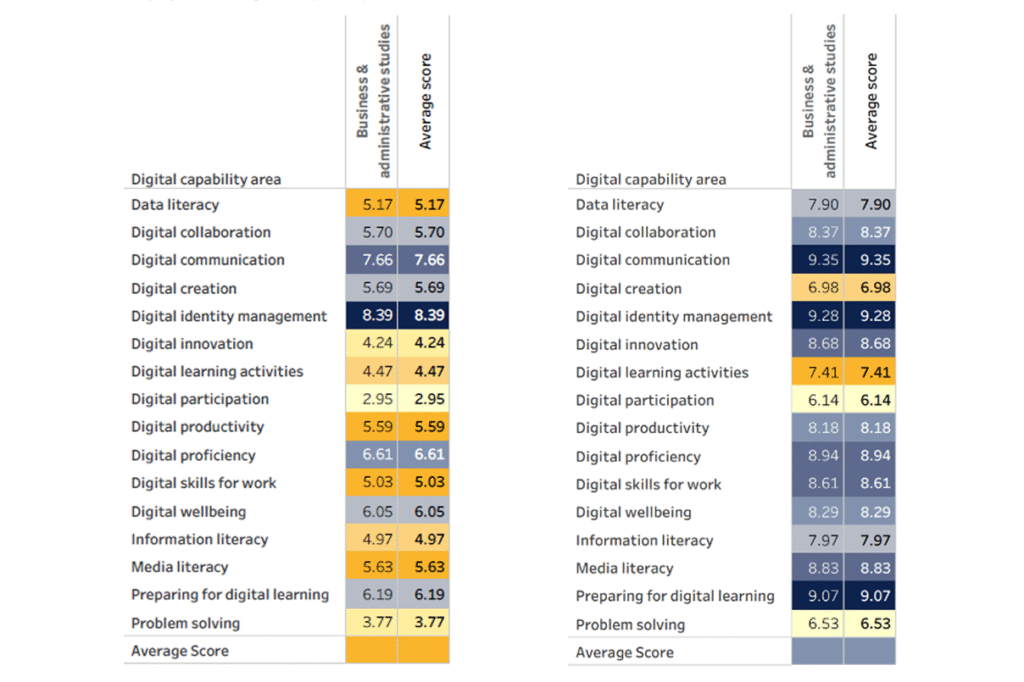
While Digital Participation (Figure 2) remained the lowest scoring capability in both assessments, students demonstrated improvements across all areas of the framework. This capability relates to joining and participating in online communities, as well as sharing and managing digital resources, and may require additional focus in future interventions. This links to a growing body of research around social media lurking defined as those peripheral members of online communities or the silent majority (McWhirter, 2025). This rise in passive online behaviour within Gen Z has been argued by some researchers to be driven by mental health and wellbeing (McKinsey Health Institute, 2023; Verduyn et al, 2022).
One particularly interesting finding was related to Digital Identity (Figure 2). Initially, this was one of the students’ strongest self-reported capability areas. However, scores decreased in the reassessment. This reduction was interpreted positively and links to the social theory of learning (Wenger, 1998). The interaction between learning as experience (actively researching their online profiles), learning as doing (mapping out their digital identities) and learning as belonging (discussing their findings within the group), led to a more informed and realistic second self-evaluation (Illeris, 2018).
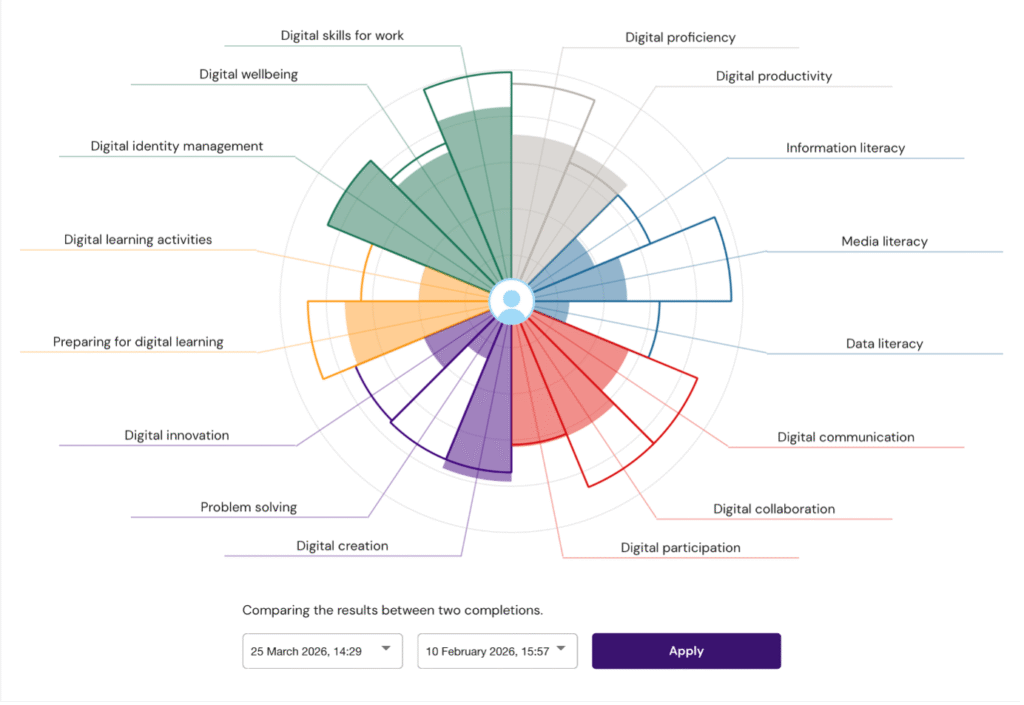
Perhaps the most significant outcome was that 100% of students who completed the reassessment demonstrated growth across all areas of the digital capabilities framework (example of growth shown in Figure 3).
Qualitative feedback reinforced these findings. Students preferred the smaller-group format and valued the supportive environment it created:
“I really think what you are doing is super cool and I’d have loved it in first year.”
Students also recognised the value of reassessment in supporting reflection and self-awareness:
“You don’t realise how much you’ve learnt until you reassess yourself. All my negative results are now positive after this experience.”
These findings suggest that digital literacy development is most effective when delivered through discussion-based, student-centred approaches rather than traditional pedagogical formats. The integration of RISE micro-credentials also provides a clear pathway for students to continue developing their skills beyond the project.
Next steps
The success of this pilot highlights the potential for wider implementation across faculties and disciplines. Future work will focus on piloting the approach in different subject areas to refine the model and compare outcomes across varied educational contexts. If you are interested in piloting the approach, please email e.conyard@mmu.ac.uk.
There is also an opportunity to undertake a longitudinal study to explore how participation in digital literacy interventions during the first year of study influences academic progression, employability, and graduate outcomes. Continued use of the Jisc framework will provide a consistent evidence base for measuring impact and informing future practice.
References
Choi, M. (2020) Digital literacy through the lens of critical thinking. Reading and Writing Quarterly, 36(2), pp. 171–189.
Department for Science, Innovation and Technology (2021) Quantifying the UK data skills gap. Available at: https://www.gov.uk/government/publications/quantifying-the-uk-data-skills-gap-full-report (Accessed: 1 July 2026).
Illeris, K. (2018) ‘An overview of the history of learning theory’, European Journal of Education, 53(1), pp. 86-101. doi:10.1111/ejed.12265.
Jisc (no date) Our digital capabilities framework. Available at: Our digital capabilities framework | Building digital capability (Accessed: 1 July 2026).
Jisc (no date) Discovery tool: student guide. Available at: Discovery tool: student guide | Building digital capability (Accessed: 4 August 2026).
McKinsey Health Institute (2023) Gen Z mental health: The impact of tech and social media. Available at: Social media and mental health: The impact on Gen Z | McKinsey (Accessed 4 August 2026).
McWhirter, A., 2025, June. Who’s afraid of the big bad lurker? Lurking, AI, and social media literacies. In Proceedings of The 11th European Conference on Social Media. Academic Conferences and publishing limited.
Salesforce (2022) Salesforce research shows unexpected skills gap among Gen Z workers. Available at: https://www.salesforce.com/uk/news/stories/salesforce-gen-z-digital-skills/ (Accessed: 1 July 2026). [salesforce.com]
Skills England (2026) Skills England: annual skills report 2026. Available at: Skills England: annual skills report 2026 (Accessed: 1 July 2026)
UK Parliament (2024) Digital skills and careers. House of Commons Library. Available at: https://commonslibrary.parliament.uk/research-briefings/cdp-2024-0073/ (Accessed: 1 July 2026)
Wenger, E. (1998) Communities of Practice: Learning, Meaning, and Identity. Cambridge: Cambridge University Press.
Verduyn, P., Gugushvili, N. and Kross, E., 2022. Do social networking sites influence well-being? The extended active-passive model. Current Directions in Psychological Science, 31(1), pp.62-68.
Zarzosa, J., & Ruvalcaba, C. (2025). Fighting Fake News: Building Cognitive Resistance and Mental Antibodies Through a Digital Media Literacy Inoculation Intervention. Journal of Marketing Education, 47(3), 196-210. https://doi.org/10.1177/02734753251319559