
All for one and one for all: Relational pedagogy and working together to build connection and learning in the Department of Social Care and Social Work
by Mark Burgess, Anne Everett, Rachael Rooke and Louise Barnes
Mark Burgess is an Academic Liaison Librarian for Health and Education programmes.
Anne Everett and Rachael Rooke are both Senior Lecturers in the Department of Social Care and Social Work.
Louise Barnes is a Programme Support Tutor in the Department of Social Care and Social Work.
Relational pedagogy emphasises human relationships in teaching and learning (Hickey and Riddle, 2023 p. 830), moving beyond the transactional delivery of content and creating more meaningful connections between educators and learners (Riddle and Hickey, 2023, p. 275). In higher education, we often talk about the importance of collaboration, co-working, and breaking down silos, but it is in the classroom working side-by-side that its true value becomes clear.
In semester one of 2025, we co-delivered two information literacy and academic skills sessions: one exploring the use of AI in academic work involving Anne, Mark, and Louise with Level 5 Health and Social Care students, and another focusing on traditional research strategies and referencing, involving Rachael and Mark with Level 4 Social Work students. These experiences highlighted the power of relational pedagogy, demonstrating that co-working and strong relationships are at the heart of effective teaching, transforming the classroom dynamic.
What is relational pedagogy?
Relational pedagogy is grounded in the belief that learning is a social process, and positions ‘meaningful relationships as fundamental to effective learning and teaching’ (Gravett, Taylor and Fairchild, 2021, p. 392). It prioritises trust, respect, and mutual engagement – creating the right ‘assemblages of forces’ – between teachers and students that make learning happen effectively (Hickey and Riddle, 2024, p. 3273).
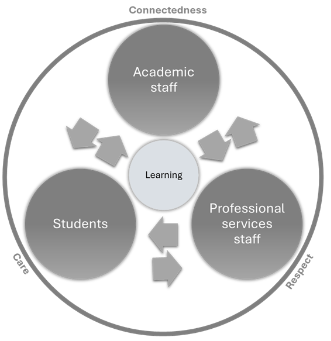
We take a broader view of “teacher”, that includes academic staff, Academic Librarians and Programme Support Tutors. The relationships involved in relational pedagogy, therefore, are not only those between the traditional teacher and student, but rather between all those involved in the teaching. Rather than positioning any one group of educators as sole authorities, it encourages collaboration, dialogue, and shared responsibility for learning. Crucially, relational pedagogy reframes knowledge as something co-constructed through interaction, rather than transmitted from expert to learner (Riddle and Hickey, 2023, p. 270). This approach is particularly relevant in information work, where information literacy is not just about skills but about empowering students to navigate complex knowledge landscapes and information systems and apply this learning, contextually, to their own areas of academic practice.
Co-teaching as a relational practice
Working together allowed us to model collaboration for students. In the AI-focused workshop, questions about reliability and academic integrity surfaced quickly. Some students were reluctant to engage with AI, often due to a fear of misusing AI and its consequences. Through co-delivery, combining disciplinary expertise with information literacy perspectives, we demonstrated that knowledge is shared and negotiated. Students saw that as educators, we approach emerging technologies with curiosity and openness, but with criticality and a healthy dose of scepticism.
In the more conventional finding information and referencing session, relational pedagogy informed our methods. Rather than delivering a one-way, didactic lecture on databases and referencing, we invited students into conversation, providing the opportunity for them to share their own experiences. Students were able to articulate their feelings about the challenges they faced when searching for information, as well as offer up their own opinions on what sources of information they trust and why. During the workshop, we engaged in a short three-way discussion about the importance and purpose of peer review, and what this looks like in practical terms when seeking peer reviewed materials – an element often understated in practical workshops like these. These interactions and questions positioned students as active contributors in their own learning, validating their experiences and encouraging further dialogue.
Why does it matter?
Relational pedagogy matters because it builds students’ sense of belonging and confidence, reinforcing that university staff are approachable, responsive, and attuned to student needs (Mitchell‑Smith et al., 2025, p. 156). This is particularly crucial to Level 4 students navigating their first year. Galve‑González et al. (2023, p. 970) identify that the sudden shift from the highly organised support typical of high school and further education to a university context, where students are expected to be more autonomous can be problematic.
Moreover, students take more intellectual risks when they feel supported. In both sessions, it was noticeable that students asked more nuanced questions once they sensed that their voices were welcomed and valued. This is critical in information literacy, where uncertainty is part of the process. By acknowledging that even experts grapple with complexity, whether in evaluating AI outputs, navigating scholarly databases or wrestling with thorny references, we normalised struggle as a route to growth.
It also matters because it shifts practice away from hierarchical models towards partnerships between all those involved in the learning. This requires reframing the concept of relational pedagogy. Rather than a simple teacher and student relationship there is a broader web of connections – between academic staff, Programme Support Staff, Library, Study Skills, Student Services – that exists to support teaching and learning, as well as the experiences and knowledge of the student. This creates a more egalitarian learning environment drawing on distinct yet overlapping areas of expertise. For librarians, this means moving beyond the ‘service provider’ identity becoming co-educators who shape learning environments collaboratively. For academic tutors, this means identifying and harnessing the expertise of other educators to enhance teaching design and delivery. For everyone involved it also means, frankly, a nicer, more positive working culture, where kindness, care and understanding shape our interactions with each other, respecting and valuing our individuality and the diverse experiences we all bring.
Finding your way
Implementing this broader concept of relational pedagogy does not require radical change; it begins with intentional practices. It involves respecting that as educators we all have value and something to bring to the table. It requires acknowledging the limitations of our knowledge and recognising where it lies. It calls for meaningful dialogue with colleagues from other teams and directorates (never underestimate the importance of going for a brew!) and developing connections and relationships. It involves inviting other educators into the same space as academics and students. Indeed, a partnership of academic staff and professional academic services staff demonstrate to students that learning is interdisciplinary and relational.
The challenge for all those in involved in the practice of relational pedagogy is maintaining momentum and the continuance of relationships when those involved move on. As the semester progresses and priorities shift with the ebb and flow of the academic year, it’s easy for those bonds and connections to take a backseat to the priorities of the day. Moreover, as people change roles or start positions elsewhere, there is a risk that knowledge, trust and ways of working are lost. To address these challenges, relational pedagogy (and the mutual respect and value of professional expertise) must be embedded in culture and values rather than a box ticking exercise.
Effective co-delivery depends on trusting each other’s abilities and knowledge, feeding off each other’s energies, openness to challenge from each other and our students, learning off each other, acknowledging the limitations of your own expertise, creating opportunities for open dialogue.
Relational pedagogy reminds us that education is fundamentally about relationships. Whether exploring AI or mastering traditional search and retrieval skills, students thrive when learning feels collaborative, respectful, and responsive. Embracing relational pedagogy allows us to move beyond teaching in isolation, towards collectively cultivating confidence, curiosity, and critical engagement.
References
Everett, A. and Burgess, M. (2025) ‘The meeting of multiliteracy minds: a partnership approach to supporting students’ AI and Information Literacy Skills’, LEED Conference. Manchester Metropolitan University, Manchester, 18 June. Available at: LEED L&T Conference 2025 – Day 1 Session C – Interactive Presentations – mmutube (Accessed: 7 January 2026)
Galve-González, C., Bernardo, A.B. and Castro-López, A. (2024) ‘Understanding the dynamics of college transitions between courses: Uncertainty associated with the decision to drop out studies among first and second year students’, European Journal of Psychology of Education, 39(2), pp. 959–978. Available at: https://doi.org/10.1007/s10212-023-00732-2
Gravett, K., Taylor, C.A. and Fairchild, N. (2021) ‘Pedagogies of mattering: re-conceptualising relational pedagogies in higher education’, Teaching in higher education, 29(2) pp. 1–16. Available at: https://doi.org/10.1080/13562517.2021.1989580
Hickey, A. and Riddle, S. (2024) ‘Proposing a conceptual framework for relational pedagogy: pedagogical informality, interface, exchange and enactment’, International Journal of Inclusive Education, 28(13), pp. 3271–3285. Available at: doi:10.1080/13603116.2023.2259906
Hickey, A., and Riddle, S. (2023). ‘The practice of relationality in classrooms: beyond relational pedagogy as empty signifier’. Teachers and Teaching, 29(7-8), 821–832. Available at: https://doi.org/10.1080/13540602.2023.2202389
Mitchell-Smith, Z., Evans, F. and Rooke, R. (2025) ‘Drawing on Lundy: A holistic approach to student voice and participation’, Student Engagement in Higher Education Journal, 7(1), pp. 150–161. Available at: https://sehej.raisenetwork.com/raise/article/view/1409 (Accessed: 25 March 2026).
Riddle, S. and Hickey, A. (2023) ‘Reclaiming relationality in education policy: towards a more authentic relational pedagogy’, Critical Studies in Education, 64(3), pp. 1–16. Available at: https://doi.org/10.1080/17508487.2022.2132414